
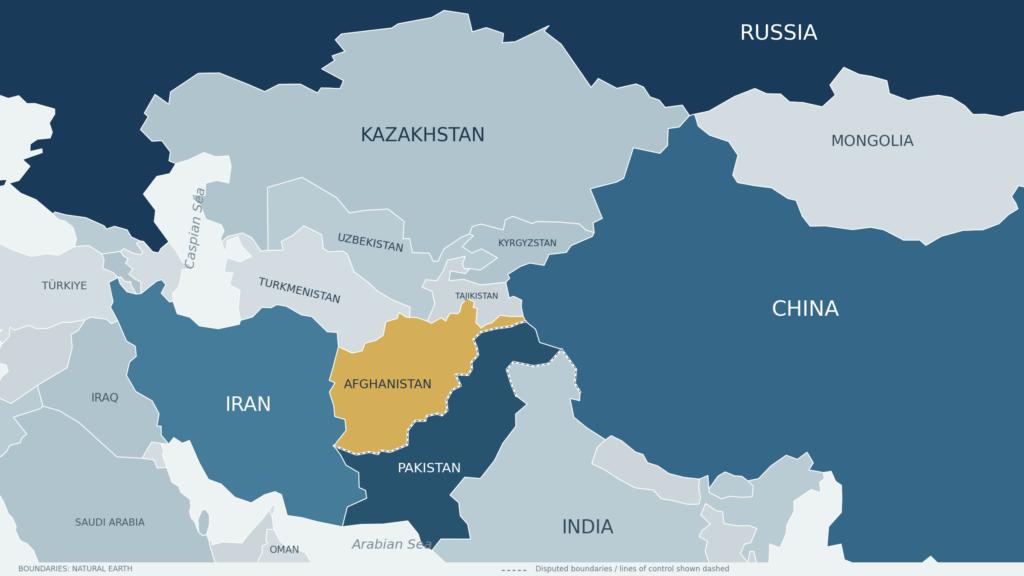
Afghanistan’s regional neighbors can accept continued instability in Afghanistan as long as threats to their own security remain manageable and that instability provides a permissive environment for supporting operations against their rivals elsewhere.
For the United States, this creates a strategic reason to support a free, functioning Afghanistan that serves its people while denying America’s strategic rivals a permissive environment for activities that threaten U.S. interests and evade effective international scrutiny.
At the eighth Moscow Format meeting on 5 October, Russia’s foreign minister praised the Taliban’s control of Afghanistan and offered closer security cooperation against ISIS and other terrorist groups. He also drew a firm line: NATO must have no military infrastructure in Afghanistan or its neighboring countries under any pretext. He spoke about aid and economic ties but offered no serious answer to Afghanistan’s political crisis or the Taliban’s exclusion of other Afghans. Moscow’s message was clear about the Afghanistan it needs: one that contains threats to Russia and Central Asia and remains closed to a Western military return and political influence.
Afghanistan attracts strategic competition without attracting strategic commitment from its neighbors. Its location matters to the powers around it. Its people, institutions, and political future matter far less to their calculations. Russia, China, Iran, and Pakistan all want influence over events in Afghanistan, but none is willing to make the creation of a functioning Afghan state the central purpose of its policy. They can deal with turmoil that Afghans cannot live with, provided threats to their own security remain manageable and that turmoil allows them to use Afghan territory to support operations against their rivals elsewhere.
This is what it means for Afghanistan to become the security frontier of others. Regional powers intervene, cooperate with Afghan rulers, or cultivate other Afghan actors when their own interests demand it. They speak of peace, but their policies are shaped by the threats they want to contain and the rivals they want to keep out. For the United States, this unresolved crisis creates opportunities for hostile actors to threaten American interests. Supporting a free, functioning Afghanistan would help close those opportunities while giving Afghans a chance to determine their own future.
Why Containment Is Enough
A country can matter greatly to its near and distant neighbors without its recovery becoming important enough for them to undertake a lasting commitment. Afghanistan’s location attracts attention because it offers access, influence, and opportunities to deny those advantages to a rival. But location alone does not make rebuilding Afghanistan worth the cost. Decades of war have damaged its institutions, national infrastructure, economy, and political relationships. The task of turning Afghanistan into a reliable economic partner requires much more than signing a mining contract or announcing a transit corridor. It requires security, predictable government, functioning institutions, and years of sustained investment.
Containment asks for much less. Regional powers can maintain relations with whoever controls Kabul, seek assurances against attacks, exchange intelligence, and cultivate other Afghan political and armed actors as insurance. Weak institutions, limited oversight, and international isolation—as under Taliban rule—leave room for regional countries to exploit Afghanistan’s instability and use its territory to build informal channels of cooperation that strengthen regional alliances and support operations against their rivals, beyond international scrutiny. These arrangements allow them to protect particular interests without taking responsibility for the conditions that keep Afghanistan unstable. They can invest in access and influence while leaving the larger task of rebuilding a functioning Afghanistan unresolved.
China’s interests illustrate this logic. Beijing has long sought to deepen cooperation with Pakistan and Iran across trade, energy, security, and nuclear development. In Afghanistan, those interests favor a weak government outside Western influence that China can influence and constrain. Taliban rule meets that requirement. In this assessment, a weak, internationally isolated Afghanistan provides a conduit through which China can move restricted materials across Pakistan and Afghan territory into Iran to support Iranian military capabilities, beyond effective international scrutiny.
The region’s threshold for an acceptable Afghanistan is therefore much lower than the threshold Afghans need for a viable country. Poverty, repression, political exclusion, and internal conflict can remain tolerable to regional powers as long as threats to their own interests stay manageable. Their urgency rises when those threats cross a border or a rival gains a foothold in Afghanistan. The suffering inside Afghanistan does not produce the same response.
The Opportunity after 9/11
It took a catastrophic event outside Afghanistan to bring the international commitment that Afghans had needed for decades. After 9/11, Afghanistan’s unresolved crisis could no longer be treated as a danger to be contained at its borders. Its consequences had reached the United States. The response brought military resources, reconstruction assistance, and a political framework intended to establish a representative government and permanent national institutions. For the first time in decades, Afghanistan had a real opportunity to secure a lasting settlement that could benefit its people, its neighbors, and the wider international community.
There was also an initial opening for regional cooperation. Even Iran worked with the United States at Bonn and pledged substantial reconstruction assistance. For a brief period, rebuilding Afghanistan appeared capable of bringing together countries whose wider interests were deeply opposed. The opportunity was imperfect, but it was real.
That convergence did not last. Regional powers increasingly judged the emerging Afghan state and the international presence through their own rivalries. Pakistan’s determination to maintain its gatekeeping role over Afghanistan and limit Indian influence drove its continued protection of the Taliban. Iran and Russia increasingly treated relations with the Taliban as instruments against American influence and armed groups that threatened their own security interests. Afghanistan’s political settlement became subordinate to calculations about who would gain power, access, and influence through it.
Afghan leadership failures and mistakes in the international intervention compounded the damage. But regional interference continuously weakened the very state that international resources were helping Afghans build. An opportunity to resolve Afghanistan’s long-term crisis was consumed by competing efforts to shape the outcome. The international commitment that could have helped Afghanistan escape its position as a security frontier became another arena for the rivalries that had kept it there for nearly five decades. The collapse of that effort left Afghanistan vulnerable once again to the regional interference it was meant to overcome, with consequences extending beyond Afghanistan’s borders.
Russia: Contain the Danger and Keep the West Out
Russia’s present approach to Afghanistan is far more limited than the Soviet ambition to control its political direction. Moscow wants an authority in Kabul that can contain armed threats, cooperate with Russian security agencies, and keep the United States and NATO from returning. A lasting settlement among Afghans is secondary to those requirements. Moscow’s insistence on keeping Western military power out also reflects a longstanding Russian preference for buffer zones, rooted in historical insecurity and deep suspicion of Western intentions.
The eighth Moscow Format meeting made that approach explicit. Lavrov praised the Taliban’s control of the country and described their governance as successful. He welcomed their campaign against ISIS and other terrorist groups, then called for material assistance, expert support, and cooperation between intelligence and law enforcement agencies. The practical offer was to help the Taliban become a more effective security partner. His speech contained no comparable demand for a political settlement with other Afghan forces, an end to the exclusion of women and girls, or limits on the Taliban’s absolute monopoly over power.
This selective approach matters. Fighting Islamic State’s regional branch, Islamic State Khorasan Province (ISKP), does not resolve Afghanistan’s wider terrorism problem, and territorial control does not resolve its political crisis. Yet Moscow is prepared to treat the Taliban’s campaign against a shared enemy as evidence of successful government. A commentary on the meeting identified precisely this gap: Russia’s emphasis on ISKP allows the wider militant landscape and the Taliban’s internal conduct to recede from its assessment.
The other firm requirement is the exclusion of Western military power. Lavrov rejected the establishment of NATO military infrastructure in Afghanistan and its neighboring countries, regardless of the justification offered. That position places a geopolitical limit on how threats from Afghanistan may be addressed: Moscow wants stronger counterterrorism capabilities in Kabul, but it rejects a Western military role in providing them.
A continuing danger from Afghanistan also gives Russia a reason to present itself as Central Asia’s necessary security protector. Moscow does not need to create those threats to benefit from them. It can draw political advantage from threats that already exist. Afghan instability can reinforce the demand for Russian protection while obstructing routes that would give Central Asian states greater independence from Russia.
Russia consequently has room to tolerate an Afghanistan whose problems remain unresolved. Its preferred balance is a Taliban government capable of containing immediate dangers, open to cooperation with Moscow, and unable or unwilling to provide a foothold for the West. Aid, trade, and diplomatic recognition can sustain that relationship without committing Russia to Afghanistan’s broader reconstruction. Research on Moscow’s Taliban policy describes the same combination of security cooperation, regional influence, and limited economic commitment.
For Moscow, success in Afghanistan means protecting Russia’s position beyond Afghanistan. It does not require resolving the crisis within it.
China: Influence without the Burden of Rebuilding
China’s approach follows much the same logic as Russia’s, with its own security concerns at the center. Beijing wants armed groups in Afghanistan kept away from Xinjiang, instability prevented from spreading into Central Asia, and Afghanistan denied to any renewed Western military presence. These objectives require relations with the authorities in Kabul. They do not require China to resolve Afghanistan’s political crisis.
The Taliban’s ability to control threats is one source of their usefulness to Beijing. China has repeatedly demanded action against East Turkestan Islamic Movement (ETIM), alongside ISKP and other militant groups. Its concern extends beyond the narrow Afghan–Chinese border: Central Asia contains economic relationships and infrastructure that Beijing has spent decades developing. Afghanistan matters partly because disorder there could threaten those interests.
This helps explain China’s accommodation of Taliban rule. Promises of inclusive government and respect for women’s rights have gone unfulfilled, yet engagement has continued. Beijing can call for changes while maintaining a relationship that serves its immediate purposes. The political conditions under which Afghans live have not become a decisive test of that relationship. Beyond containing threats, Beijing’s relationship with the Taliban serves its wider cooperation with Pakistan and Iran.
Afghan minerals and transit routes give China additional opportunities, but opportunity should not be confused with necessity. China’s economy does not depend on an Afghan corridor becoming operational. The proposed Wakhan route could provide another option, reduce dependence on Pakistan, and expand Chinese access across the region. But it would require considerable investment and security arrangements, and it would not replace maritime transport for the bulk of Chinese trade. Beijing can therefore wait, assess, negotiate, and postpone commitments in ways Afghanistan cannot afford to do.
Mining contracts, commercial access, and promises of investment also have political value before their full economic potential is realized. They give Beijing channels into the Taliban administration and provide Afghan rulers with reasons to maintain the relationship. China can pursue particular projects and cultivate influential actors without undertaking the much larger task of rebuilding Afghan institutions.
The result is considerable room for Chinese patience. As long as armed threats remain contained and rival powers gain no dangerous foothold, Afghanistan’s poverty, repression, and unresolved political divisions do not compel Beijing to change course. They may obstruct individual projects, but they do not necessarily defeat China’s broader strategy.
China wants Afghanistan to be manageable. It has yet to make Afghanistan’s recovery important enough to justify the commitment that recovery requires.
Iran: Deal with the Taliban and Keep Other Options Open
Iran faces Afghanistan’s problems more directly than Russia or China. Its concerns include armed groups, separatist networks, narcotics, refugees, and water disputes. It also wants to prevent Afghanistan from becoming a base for American pressure against it. These concerns give Tehran strong reasons to engage with Kabul, but they do not amount to a commitment to resolve Afghanistan’s political crisis.
For now, Iran deals with the Taliban because they control the country and remain a government with which it can negotiate. Tehran does not need to trust them to find the relationship useful. It needs them to contain threats, manage border disputes, and avoid a strategic alignment with the United States. Iranian analysis and policy have long treatedengagement with the Taliban as a way to manage these dangers.
The relationship therefore rests on the Taliban’s conduct toward Iranian interests. A failure to contain armed threats, or a substantial opening toward Washington, could change Tehran’s calculation. Iran’s present dealings with the Taliban should be understood as a practical arrangement that can be adjusted as those interests change.
Beyond containing threats, Tehran benefits from access through Afghan territory to supplies and networks that strengthen its position against its rivals. The Dogharoon Free Zone on the Iranian side of the border, together with the proposed free-zone development on the Afghan side, offers opportunities to expand Iranian influence beyond commerce. These interests reinforce Tehran’s willingness to work with the Taliban as long as they accommodate Iranian interests and keep Afghanistan closed to an American military presence and political influence.
Iran also has Afghan connections beyond the Taliban. Its longstanding relationships with Shia communities and political actors, together with its recruitment of Afghan fighters into the Fatemiyoun, give it networks that could become useful under different circumstances. The Fatemiyoun’s Iranian sponsorship and deployment in Syria are well documented. Those connections give Tehran options without requiring it to activate an Afghan force against the Taliban today.
Tehran can negotiate with the Taliban while preserving relationships with actors who might provide leverage if negotiations cease to work. Afghan opposition groups seeking Iranian help would enter that calculation. Their desire to change Afghanistan’s government would meet Iran’s desire to protect its own position, and the two purposes would not necessarily remain aligned.
Iran continues to call for inclusive government. At the latest Moscow Format meeting, its ambassador again linked lasting stability to an inclusive political structure and opposition to foreign military bases. But Tehran’s continued dealings with the Taliban show that political inclusion is an aspiration it can leave unfulfilled while pursuing more immediate requirements.
Iran’s commitment is to protecting its interests in Afghanistan. Its relationship with whoever rules Kabul depends on how well that ruler serves those interests.
Pakistan: Instability as a Source of Influence
Pakistan is the most complicated of the four countries. It maintains relationships across competing camps and seeks a role in almost every discussion about Afghanistan. It works with China, engages Russia and Iran, and seeks continued relevance to the United States and its allies. Its enduring opposition is to Indian influence. Afghanistan sits at the intersection of these relationships, giving Pakistan opportunities to bargain with powers that otherwise disagree.
Pakistan’s concern has therefore never been simply whether Afghanistan is stable. It is whether Afghanistan is stable on terms Pakistan can control. A functioning Afghan state would make its own foreign-policy decisions, establish direct international relationships, and refuse a Pakistani veto over cooperation with India. Pakistan’s pursuit of strategic depth has repeatedly brought it into conflict with that independence. Earlier analysis of its support for the Taliban identified precisely this calculation: influence over Kabul and limits on Afghan-Indian cooperation.
Afghan instability also gives Pakistan a valuable international role. During the Cold War, the war in Afghanistan turned Pakistan into a principal channel for Western assistance to Afghan fighters and brought renewed military and economic support to Islamabad. Afghanistan’s crisis made Pakistan indispensable to an international policy that it could help shape. That experience established a powerful incentive to preserve the role of intermediary.
The circumstances have changed, but the opportunity remains. Pakistan can present itself as a necessary source of intelligence, access, and cooperation against threats associated with Afghanistan. Its counterterrorism relationship with Washington continues, including a bilateral dialogue held in August 2026. A politically isolated Afghanistan gives Islamabad more room to claim that outside powers must work through Pakistan to understand and influence events there.
The current conflict with the Taliban does not erase this logic. At the latest Moscow meeting, Pakistan accused several armed groups of operating from Afghan territory, while the Taliban accused Pakistan of organizing threats against them. Their dispute helped prevent agreement on a joint statement. Islamabad is now confronting an Afghan authority it once supported, but its demand remains familiar: Kabul must act according to Pakistan’s security requirements.
Taliban rule also creates openings for Pakistan beyond its relationship with the Taliban themselves. Repression, political exclusion, and international isolation push other Afghan actors to seek help abroad. At an Islamabad conference in September, Afghan opposition figures discussed their struggle against the Taliban, and one former parliamentarian declared his willingness to cooperate with any country offering support. Pakistan once again becomes a place where Afghan actors search for the means to fight an Afghan rival.
This gives Islamabad options. It can pressure the Taliban, engage their opponents, and present itself to outside powers as a necessary participant in managing the resulting crisis. It can also place Afghanistan at the center of explanations for insecurity inside Pakistan, directing attention toward Afghan territory and away from the policies and militant networks that developed within Pakistan itself.
Pakistan suffers real costs from Afghan instability. But those costs coexist with opportunities for influence, diplomatic relevance, and outside support. The failure of one Afghan relationship can become the reason to cultivate another.
A functioning Afghanistan would deal directly with the world. A divided Afghanistan keeps giving Pakistan a role in deciding how the world deals with it.
Why Containment Is Not Enough for the United States
Containing terrorist threats alone does not address Afghanistan’s wider strategic significance. China’s cooperation with Pakistan and Iran spans economic development, security, nuclear development, trade, and oil. The United States and its allies cannot afford to assess Afghanistan separately from these relationships. What happens on Afghan territory can affect American national security, regional stability, and international security.
As argued earlier, a weak Afghan government outside Western influence serves Beijing’s interests. Taliban rule leaves Afghanistan vulnerable to external influence and its territory available for activities beyond effective international scrutiny. In this assessment, the route from China through Pakistan and Afghanistan into Iran provides a conduit through which China can move restricted materials to support Iranian military capabilities. The American and allied presence previously gave Washington greater capacity to monitor and challenge such uses of Afghan territory. Their withdrawal reduced that capacity.
The consequences extend beyond Afghanistan and Iran. Tehran’s competition with Saudi Arabia for regional influence gives it reasons to strengthen partners capable of putting pressure on Riyadh. Iranian support for the Houthis in Yemen enables threats against Saudi territory and infrastructure. Greater Iranian military capacity can intensify those pressures, drawing additional American and allied resources into protecting Saudi Arabia and other regional partners.
A stronger Iranian capacity to threaten the Strait of Hormuz also puts energy supplies, international shipping, and American allies at risk. Heightened threats to Israel can prompt further Israeli military action, increasing the danger of a wider regional conflict. Afghanistan is one part of this larger strategic picture, but leaving its territory available to support these networks carries consequences that a narrow counterterrorism policy cannot address.
The United States therefore has an interest in rebuilding a partnership with a free, functioning Afghanistan that is friendly to the West and capable of controlling its own territory. An arrangement with the Taliban would leave cooperation dependent on the calculations of a ruling group whose overriding concern is its own survival. A government accountable to a broader Afghan public would face greater pressure to protect national interests, while functioning institutions would make undisclosed agreements and the unchecked use of its territory harder to sustain. A responsible government would also respect international norms governing such activities and cooperate with international scrutiny and monitoring. Supporting Afghan sovereignty would help constrain activities that strengthen hostile actors while giving Afghans greater control over their political future.
The purpose of this partnership is to uphold Afghan sovereignty and effective control over its territory, preventing its use to harm the United States or any other country. It is not an alliance against the region. It is an alliance first and foremost for the wellbeing of the Afghan people, with benefits for the region and the wider world.
Such a partnership requires a political order broader than Taliban monopoly rule. American and Western support should help Afghans build the leverage needed to press the Taliban to share power with other Afghan groups as equal participants in government or relinquish power. The task is to rebuild the Afghan–Western partnership broken in 2021 around a political settlement that serves Afghan freedom and lasting common interests.
A Frontier without a Settlement
These four countries differ in their interests, relationships, and capacity to influence Afghanistan. Russia and China have more distance from its immediate problems. Iran and Pakistan face consequences along their borders. Pakistan also seeks an intermediary role with Western powers that distinguishes it from the others. Yet across these differences, a common priority remains: protect their own position without undertaking the larger commitment Afghanistan’s recovery requires.
Containment also has a weakness: the conditions left unresolved can keep producing the dangers the region wants controlled. Repression closes peaceful paths for political change. Exclusion encourages opponents to seek outside patrons. Poverty and weak institutions leave people vulnerable to exploitation by terrorists. A security arrangement with Kabul may reduce an immediate threat while leaving its sources intact.
But a temporary arrangement can still be satisfactory to a regional power. It can be renegotiated, reinforced, or replaced as circumstances change. Afghans bear the continuing cost of living within those arrangements. What counts as manageable instability from Moscow, Beijing, Tehran, or Islamabad can mean another lost generation inside Afghanistan.
Afghanistan’s neighbors have found ways to live with its crisis. Afghans have not. For regional governments, the question is whether danger can be contained and rival influence kept within acceptable limits. For people inside Afghanistan, the question is whether they can obtain an education, earn a living, participate in public life, and have a future beyond repression and recurring conflict.
Afghanistan attracts strategic competition without attracting strategic commitment. Its location gives regional powers reasons to interfere, negotiate, and cultivate influence. Its unresolved crisis leaves room for them to contain threats to themselves while using Afghan territory to support operations against their rivals elsewhere. For the United States, accepting that arrangement carries costs beyond Afghanistan. Supporting a free, functioning Afghanistan would help protect American interests while enabling Afghans to reclaim control over their country and its future.